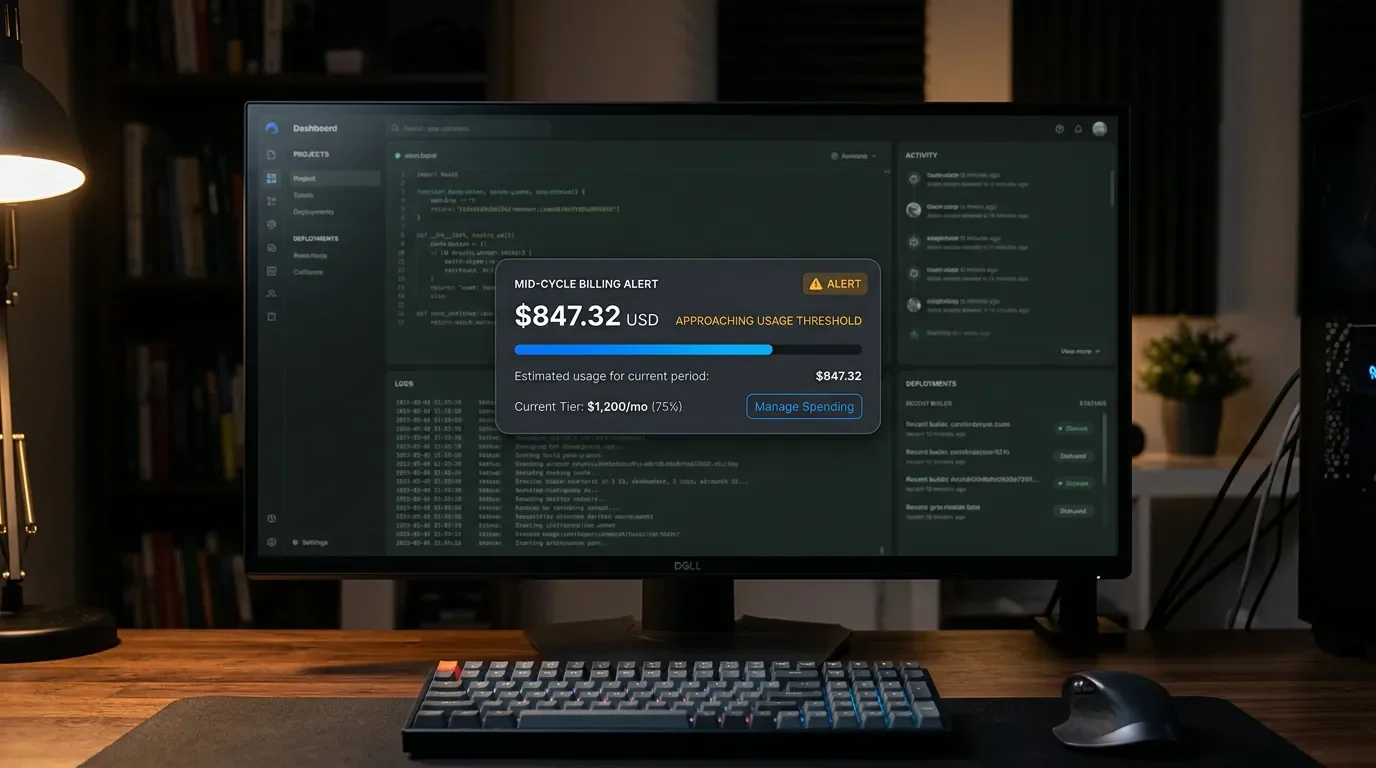
Vercel now sends Pro teams mid-cycle invoices
On June 10 Vercel enabled threshold billing for all Pro teams — when on-demand usage crosses a threshold mid-cycle, a partial invoice fires immediately rather than waiting for month-end. The total charge stays the same; only the timing changes. Here's what it means for teams with automated billing workflows, and what to check before your next cycle.

On June 10, 2026, Vercel enabled threshold billing for all Pro teams. 1 The change is live now — no opt-in required. If your team's on-demand usage crosses a threshold during the billing cycle, Vercel will issue a partial invoice before the cycle ends rather than holding the entire amount until month-end.
This is not a price increase. The total amount you pay for a given usage level stays the same. What changed is when the money moves — and for any team with automated payment workflows, Stripe invoice webhooks, or finance approvals tied to end-of-month Vercel invoices, that timing shift is a production change worth handling before it surprises you.
What actually changed
Before June 10, Vercel Pro teams received a single invoice at the end of each billing cycle covering all usage that month. On-demand charges — bandwidth overages, serverless function invocations beyond the plan's included allowance, Edge Middleware, and similar consumption-based items — all accumulated silently and settled in one shot at month-end.
Now, Vercel monitors on-demand usage in real time and issues a partial invoice the moment cumulative on-demand charges cross a threshold. 1 The threshold dollar amount is not published as a specific figure — Vercel describes it as the point at which "on-demand usage reaches a threshold," indicating the trigger is determined per-team based on plan configuration or historical usage patterns.
The end-of-cycle invoice still arrives at the end of the month. It covers any remaining on-demand usage that accumulated after the partial invoice was issued, plus the fixed Pro subscription fee.
How the math works
The core guarantee is this: partial invoice plus end-of-cycle invoice equals your total usage charge. The same usage is never billed twice. 1
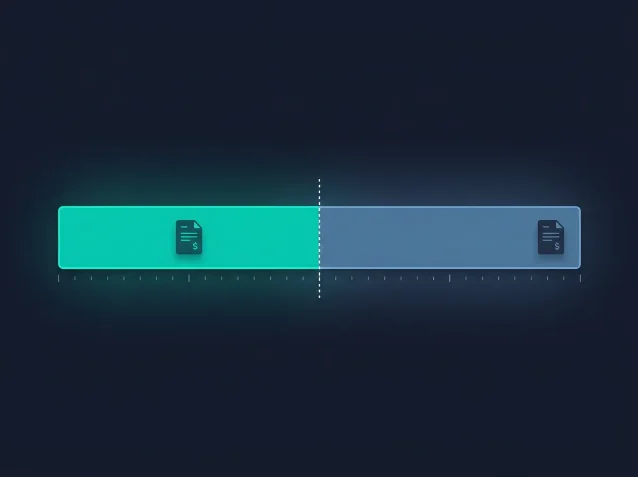
A concrete example:
| Scenario | Before (Jun 9) | After (Jun 10+) |
|---|---|---|
| Fixed Pro subscription | Billed at month-end | Billed at month-end |
| On-demand usage below threshold | Billed at month-end | Billed at month-end |
| On-demand usage crossed threshold mid-cycle | Billed at month-end | Partial invoice issued mid-cycle |
| Remaining on-demand after partial invoice | — | Covered by end-of-cycle invoice |
| Total charge for same usage level | $Y | $Y (identical) |
If your usage never crosses the threshold in a given month, you see no change. The billing cycle looks exactly like it did before June 9.
The practical concern is not double-billing — that's explicitly ruled out. The concern is timing. If your payment method has a per-transaction limit, or if a declined partial-invoice charge triggers a billing hold on your account, that can affect deployment capacity mid-cycle. Vercel's partial invoice documentation covers what happens when a partial invoice fails to collect. 2
The platform signal behind the change
Threshold billing doesn't exist in isolation. The day before — June 9 — Vercel shipped spend budgets for AI Gateway API keys, letting teams set hard dollar caps per API key with
daily, weekly, monthly, or none refresh cycles. 3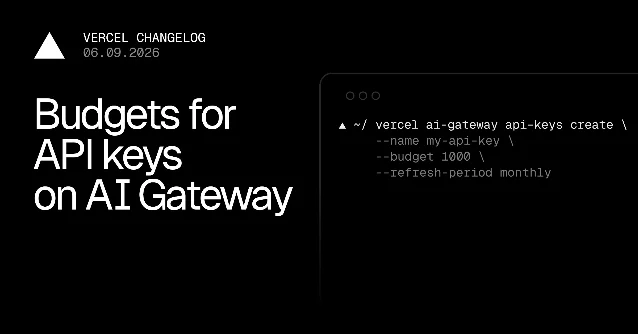
The two changes together describe a consistent platform direction: finer-grained spend control and more frequent billing events, rather than the traditional SaaS model of one charge per month. The Vercel changelog frames the motivation directly: AI-driven workloads introduce cost unpredictability that postpaid monthly billing handles poorly — "Autonomous workflows that can loop or fan out without supervision... Demos and prototypes that could catch unexpected traffic if shared or shipped." 3
Threshold billing addresses the same root problem from the platform's side: rather than absorbing the cash-flow risk of large end-of-month reconciliations, Vercel collects earlier when usage is high. AWS and GCP have offered analogous mid-cycle billing triggers for high-usage customers for years. Vercel, with its Pro tier now competing for production AI workloads, is aligning with that pattern.
Who actually feels this
Whether this change surfaces in your day-to-day depends on your usage profile.
Loading chart…
Flat or lightly variable usage — teams whose on-demand charges stay well below threshold each month will see no change. Their billing cycle looks identical to pre-June 10. For the majority of small-to-mid Vercel Pro teams, this is a background change that never fires.
High variable usage — teams running traffic-sensitive apps, large-scale image optimization, or heavy serverless function invocations mid-month are most likely to see partial invoices. If you've had months where on-demand charges ran into the hundreds of dollars, threshold billing will likely trigger.
AI Gateway-heavy users — teams routing significant AI inference through Vercel AI Gateway have two relevant changes to handle simultaneously: the new per-API-key spend caps (which they can now set proactively) and threshold billing (which fires automatically on accumulated on-demand charges). These two mechanisms work at different layers. Spend caps prevent a key from generating more usage once the cap is hit. Threshold billing is the platform collecting on usage that already occurred.
What to do before your next cycle
Three things are worth checking now.
1. Payment method resilience. Make sure the payment method on your Vercel account can absorb a mid-cycle charge without triggering a fraud hold or hitting a per-transaction limit. A declined partial invoice could affect your team's deployment access.
2. Billing webhook integrations. If your team has built automation that fires on Vercel invoice events — Slack notifications, finance system entries, cost-allocation tagging — those integrations now need to handle partial invoices as a separate event type, not just the end-of-cycle invoice. The Vercel
invoice.paid webhook event fires for both. 23. Set spend limits if you want to prevent the trigger. The cleanest way to keep threshold billing from firing is to limit usage before it can cross the threshold. For AI Gateway specifically, per-API-key spend caps are the right tool:
vercel ai-gateway api-keys create \
  --name my-production-key \
  --budget 200 \
  --refresh-period monthly
For non-AI on-demand usage (bandwidth, function invocations), Vercel's existing spend management settings in the dashboard apply. There is no current mechanism to disable threshold billing for a Pro account — it's on by default for all Pro teams as of June 10.
The partial invoice documentation at
vercel.com/docs/pricing/understanding-my-invoice#partial-invoices covers invoice structure and failure handling in full detail. 2The billing change requires no migration and no code changes. But for teams that treat their Vercel bill as a pure end-of-month line item — particularly those with automated finance workflows — a mid-cycle invoice is a new event class that will arrive without warning the first time it fires.
Cover image: AI-generated illustration.
Add more perspectives or context around this Post.